
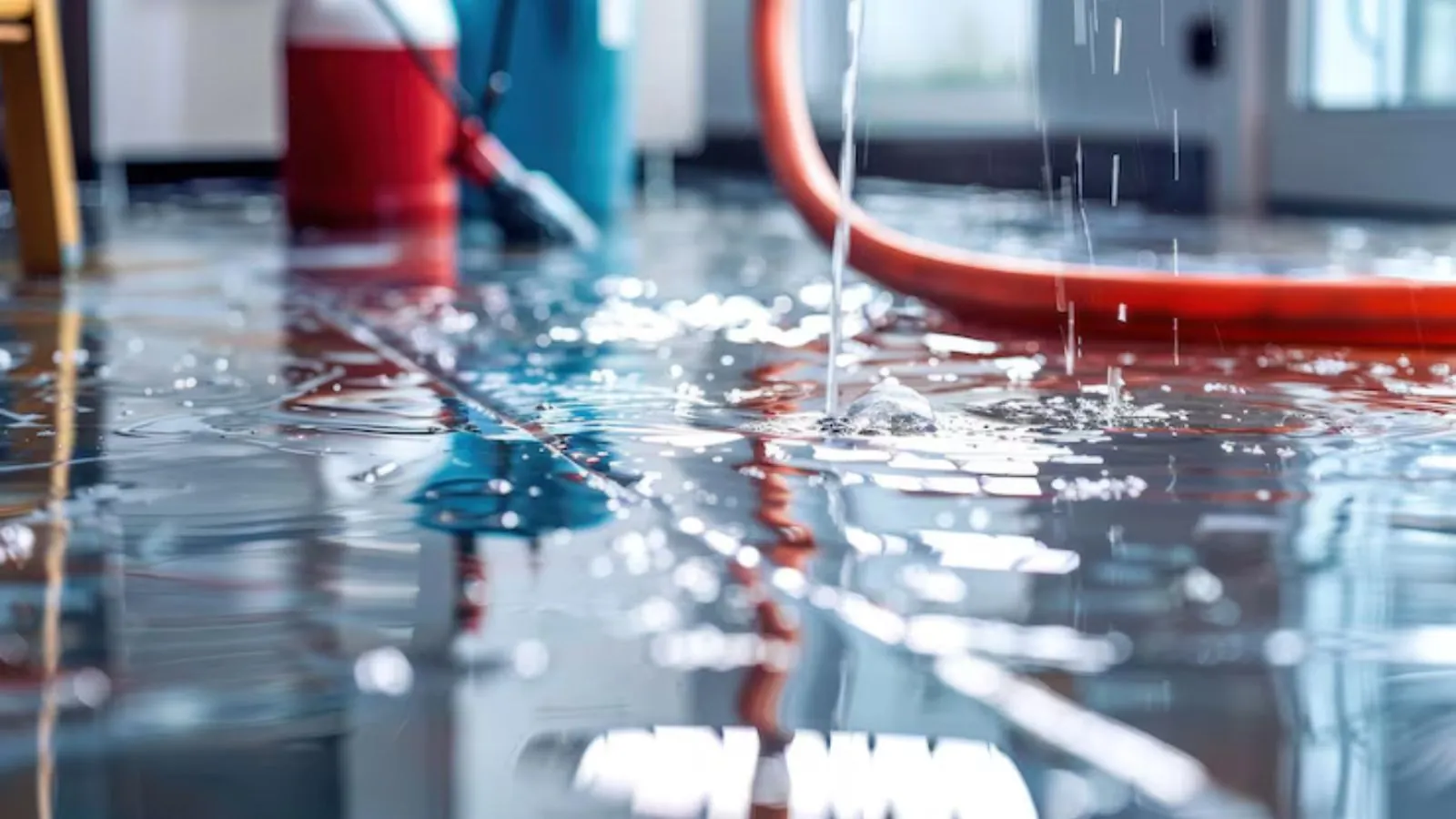
Not every leak needs a restoration company. We would sooner tell you that than have you pay for equipment you did not need. The catch is that the cases you can handle yourself and the ones you cannot often look alike in the first hour.
Question 1: What kind of water is it?
| Water | Examples | Do it yourself? |
|---|---|---|
| Clean, Category 1 | Supply line, tap left running, rain through an open window | Yes, if the other answers allow |
| Gray, Category 2 | Washer or dishwasher discharge, aquarium, toilet overflow with no solids | Only on hard surfaces, with gloves |
| Black, Category 3 | Sewage, river or surface flood water | No |
Category 3 is not a judgment call. It carries pathogens, and household vacuums and fans spread them. See our sewage backup cleanup page for why soaked materials are removed.
Question 2: How much, and how far did it go?
A few square feet on one floor is manageable. Water that crossed a room, ran under a wall, or dripped through to the floor below is not, because you cannot see where it stopped.
Question 3: How long has it been wet?
Under a day, clean water gives you time. After two days, materials that stayed damp are at real risk of mold, and clean water is no longer treated as clean.
Question 4: What got wet?
- Tile, sealed concrete, vinyl sheet: wipe, mop, dry. Usually fine.
- Carpet with pad: the pad holds water you cannot reach from above.
- Drywall: wicks water upward and holds it in the paper.
- Insulation: does not dry in a closed cavity.
- Hardwood: cups if dried unevenly.
- Laminate: swells and rarely recovers.
If only the first group is involved, you can very likely handle it.
How to dry a small clean spill properly
- Stop the source.
- Check that no water is near outlets or cords. If it is, switch off that circuit from a dry panel first.
- Blot and mop up all the standing water. A wet vacuum rated for water helps.
- Move furniture and rugs off the wet area.
- Run fans across the surface and a dehumidifier in the room, with doors and windows closed.
- Keep the heat or air conditioning on.
- Check again each day for three days: touch, smell, and look at the baseboards.
A fan alone moves damp air around. It is the dehumidifier that removes the water from the room.
Signs you have reached your limit
- The carpet squelches or the pad is wet.
- A baseboard has swelled or pulled away.
- Paint is bubbling on the wall.
- The ceiling below shows a mark.
- It still smells damp after two days.
- You are not sure where the water went.
Any of these means water is somewhere your towels cannot reach. Wet carpet and pad are explained on our carpet water damage page.
What professionals have that you do not
A household dehumidifier removes a few pints a day. A commercial LGR unit removes many times that. Extraction units pull water out of pad and subfloor. Moisture meters show whether the inside of a wall is wet.
The other thing is proof. A drying log shows the materials reached normal readings. That matters if you later sell the house or make an insurance claim.
Safety comes first, every time
Never wade into water that could be touching outlets, cords or appliances. Never use a household vacuum on sewage. If a ceiling is sagging, stay out from under it. For any electrical or gas concern, call the utility or 911 before anyone else.
The honest middle ground
Sometimes the right answer is to do the first response yourself and then have it checked. Stop the water, mop up, set a fan, and call for a moisture reading. If the readings are normal, you are done.
For Homeowners in Delaware, Ohio
Know which water you are dealing with. Inside the city, drinking water comes from City of Delaware Public Utilities, drawn mainly from the Olentangy River and blended with deep groundwater before treatment. Water from that supply is Category 1 when it leaves the pipe. Source type: the city utility's system description.
The city's sewer system is separate, with about 175 miles of sewer line and 12 pump stations. Anything that comes up a floor drain belongs to that side and is Category 3, however clear it looks. Do not try to dry it yourself.
The same rule applies in Lewis Center and in Ostrander, where the village runs the sewer.
Do-It-Yourself Drying Questions
Is tap water in Delaware, OH safe to clean up myself after a leak?
Water from the city supply starts as clean Category 1 water, so a small, recent leak on hard flooring is usually manageable. It degrades as it sits or passes through building materials, so act quickly.
How long should I run fans after a leak?
Until the area is dry to a moisture meter, not just to the touch. For a small spill on a hard floor that is usually a day or two.
Can I rent drying equipment myself?
Rental stores offer air movers and dehumidifiers. They help with small clean losses. Without a meter you will not know when to stop, and they do not replace extraction.
Question not listed? Talk it through with the 24/7 line at (833) 521-1033.