
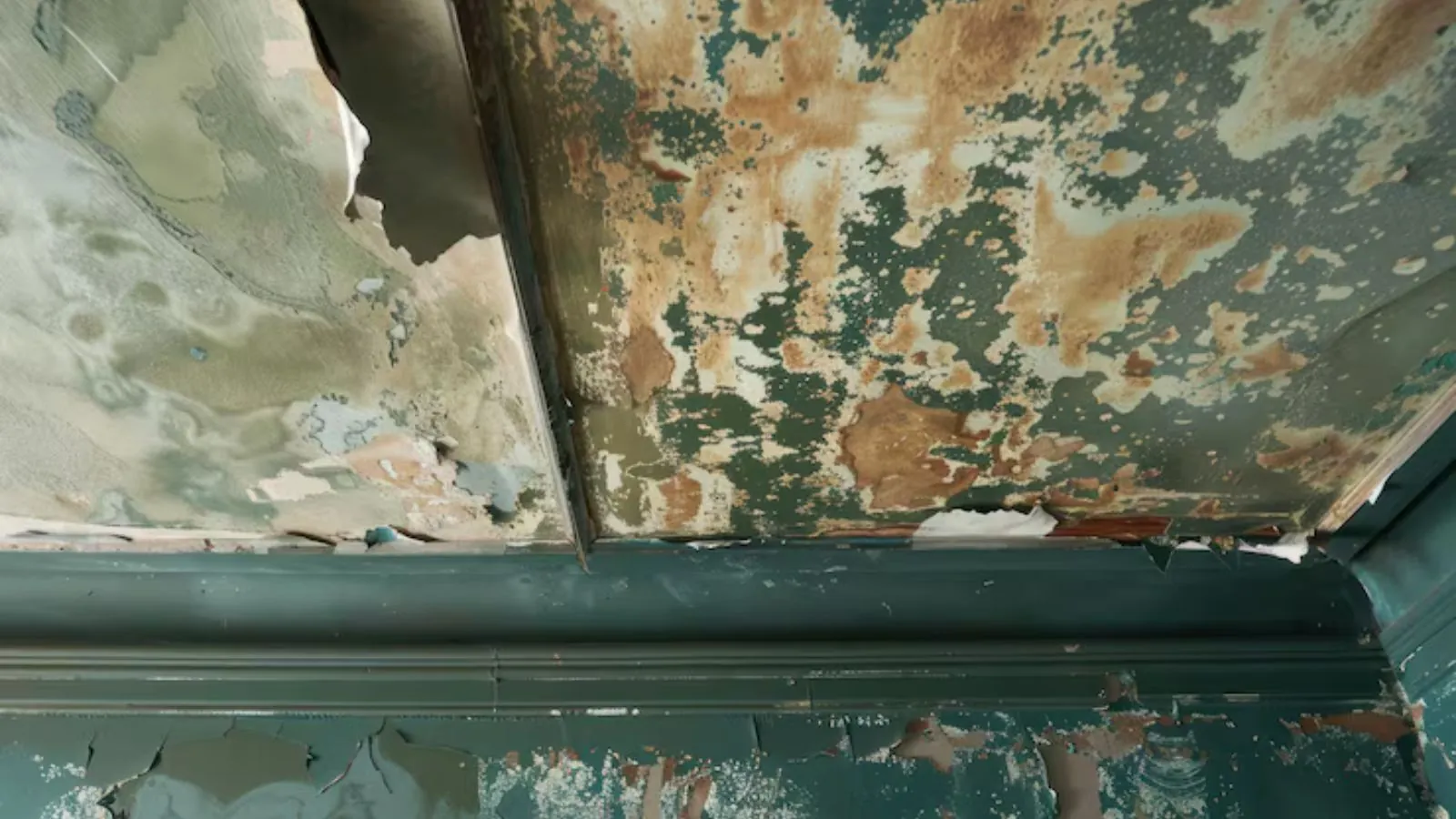
You find a brown ring on a ceiling. Perhaps you are viewing a house, or you have just moved a wardrobe. The question is whether water is still getting in. The stain cannot tell you by color alone, but a few checks together usually can.
Check 1: Touch
Press gently. New damage feels soft, cool or damp, and the surface may give slightly. Old damage that has dried is hard and often brittle. Plaster and drywall that have been wet many times can crumble at the edges.
Do not press on a ceiling that is sagging. That is water pooled above it, and it is an active leak.
Check 2: Rings
A single stain with a soft, uneven edge usually comes from one event. Several rings inside each other, like the rings of a tree, mean the area got wet, dried, and got wet again. Each ring is a separate episode.
Repeated rings tell you the cause was never fixed, even if the stain is dry today. That is common under roof flashing and around bathroom plumbing.
Check 3: Color and edges
Fresh stains are often darker in the middle and uneven. Older ones fade to yellow or tan with a sharp, dry outline. Mold spotting, peeling paint in sheets and rust around nail heads all point to dampness that lasted.
Color alone is unreliable, though. A coat of paint can hide an old stain completely, and some sellers know it. Look for a patch of ceiling that is slightly flatter or brighter than the rest.
Check 4: Smell
A damp, earthy smell means moisture is present now or was very recently. A dry old stain does not smell. Check inside closets and cabinets near the stain, where air does not move.
Check 5: Measure
This is the one that settles it. A moisture meter compares the stained area with a dry area of the same material. If the two match, the stain is historical. If the stain reads higher, something is still wet.
Take the reading again after rain, and again after someone has showered or run the washing machine. A leak that only shows under certain conditions will give itself away.
Putting the clues together
| Sign | Points to old | Points to active |
|---|---|---|
| Feel | Hard, dry, brittle | Soft, cool, damp |
| Rings | Sharp, faded | Dark, spreading edge |
| Smell | None | Musty |
| Meter | Same as dry reference | Higher than dry reference |
| After rain or use | No change | Grows or darkens |
Where "old" stains most often turn out to be active
Some locations deserve extra suspicion, because the leak behind them comes and goes.
- Below a bathroom: the stain grows only when the shower or tub is used.
- Around a chimney or roof vent: it grows only in wind-driven rain.
- Under an attic air handler: it appears in the cooling season and dries out in autumn.
- Beneath a window: it shows after storms from one direction.
- Near an outside wall in winter: it can follow a thaw.
In each case the ceiling may read dry on the day you look. If the pattern fits one of these, test it again when the conditions return, or ask for the cavity to be checked.
If it is old
An old, dry stain with a known, repaired cause is a cosmetic job. Prime with a stain blocker and repaint. If you do not know the cause, find it before painting, because the stain will come back.
If it is active
Stop using whatever feeds it if you can identify it. Then get the area opened and dried. Overhead stains are covered on our ceiling water damage repair page, and stains on walls on the wall and drywall page.
For home buyers
A home inspector notes stains but usually cannot say whether they are active. Ask the seller in writing what caused the stain and when it was repaired. Ask for the invoice. A moisture reading during the inspection period is cheap compared with finding out later.
Buying or Owning an Older House in Delaware
Delaware was founded in 1808, and the Historic Northwest Neighborhood, bounded by the Olentangy River, William Street, Pennsylvania Avenue and Euclid Avenue, has more than 500 homes and carriage houses on the National Register. Source type: the neighborhood association's published boundaries and description.
A house that has stood for a century or more has almost certainly been wet somewhere at some point. Old stains in such a house are normal and are not, by themselves, a reason to walk away. What matters is whether the meter says they are dry now.
The same checks apply to older village houses in Ostrander and Radnor.
Old Versus New Damage Questions
Are old water stains normal in Delaware's historic homes?
In houses a century old or more, yes, some history of leaks is expected. The test is whether the area reads dry today and whether the cause was repaired.
Can a home inspector tell how old water damage is?
Not precisely. An inspector can describe what is visible and take a moisture reading. Dating a stain exactly is not possible from appearance.
Does old water damage mean there is mold?
Not always. It depends how long the area stayed wet. If a stain has rings from repeated wetting, it is worth having the cavity checked.
Question not listed? Talk it through with the 24/7 line at (833) 521-1033.